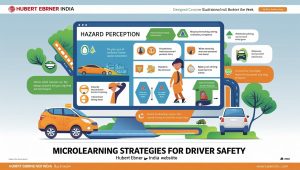
In India’s fast-growing logistics ecosystem, commercial driver safety training has become a mission-critical investment rather than a regulatory formality. With increasing delivery volumes, tighter timelines, and more complex road environments, logistics companies face mounting pressure to protect drivers, cargo, and brand reputation. Organizations that implement structured safety programs are seeing measurable improvements in fleet performance, cost control, and operational reliability.
For logistics operators managing medium and heavy commercial vehicles, driver behavior remains the single most influential factor in road incidents. Even experienced drivers can develop risky habits over time, especially under delivery pressure. Modern safety training addresses this gap by combining behavior-focused learning with real-world scenario practice—an approach strongly emphasized by Hubert Ebner India’s advanced training ecosystem.
commercial driver safety training reduces accident frequency
Accident prevention is the most immediate and visible benefit of structured driver education. Logistics fleets operate long hours, often in congested urban corridors and unpredictable highway conditions. Without continuous skill reinforcement, drivers may overlook emerging hazards or react too late.
Professional safety programs strengthen critical competencies such as:
-
Hazard anticipation
-
Safe following distance
-
Speed discipline
-
Fatigue awareness
-
Defensive maneuvering
When drivers consistently apply these principles, incident rates drop significantly. For logistics companies, this means fewer vehicle repairs, reduced cargo damage, and minimal service disruptions.
Hubert Ebner India enhances this impact through simulator-based learning, allowing drivers to experience high-risk situations in a controlled environment. This practical exposure builds decision-making confidence that traditional classroom-only training rarely achieves.
commercial driver safety training improves fleet efficiency
Safety and efficiency go hand in hand in logistics operations. Aggressive or inconsistent driving behaviors increase fuel consumption, accelerate component wear, and create unpredictable delivery timelines. Over large fleets, these inefficiencies translate into substantial operational costs.
Structured training promotes smoother and more controlled driving habits. Drivers learn to maintain optimal speed patterns, anticipate traffic flow, and avoid unnecessary braking or acceleration. The result is a more disciplined fleet that operates with greater consistency.
Logistics companies typically observe:
-
Improved fuel economy
-
Reduced tire and brake wear
-
Lower vehicle maintenance costs
-
More reliable delivery schedules
These improvements directly strengthen profit margins while also extending vehicle lifespan. In a highly competitive logistics market, such gains can create meaningful operational advantage.
commercial driver safety training strengthens compliance readiness
In 2026, regulatory expectations and corporate duty-of-care standards are becoming increasingly stringent. Logistics companies are expected to demonstrate that they are proactively managing driver risk rather than reacting after incidents occur.
Structured safety programs help organizations:
-
Meet internal audit requirements
-
Support insurance negotiations
-
Align with global safety standards
-
Demonstrate employee welfare commitment
Many large clients and multinational partners now evaluate logistics vendors based on their safety practices. Companies that invest in formal driver development are better positioned to win and retain high-value contracts.
Hubert Ebner India supports compliance-focused organizations by providing measurable training outcomes and performance analytics. This data-driven approach helps safety managers move beyond attendance records to actual competency improvement.
Why logistics companies in India are prioritizing driver training
Several industry trends are accelerating adoption across the logistics sector:
E-commerce expansion: Last-mile delivery growth has dramatically increased fleet exposure to dense traffic environments.
Rising insurance scrutiny: Insurers increasingly reward companies that demonstrate structured risk-reduction initiatives.
Driver shortage challenges: Skilled drivers are in high demand, making retention and upskilling more important than ever.
Technology-enabled monitoring: Telematics data is revealing risky driving patterns that require targeted training interventions.
Because of these factors, progressive logistics companies are shifting from one-time induction programs to continuous driver development models.
The Hubert Ebner India advantage
Hubert Ebner India has established itself as a trusted partner for logistics organizations seeking measurable safety improvements. Their training methodology integrates behavioral science, high-fidelity simulation, and performance analytics to create lasting driver skill enhancement.
Key differentiators include:
-
Realistic commercial vehicle scenarios
-
Risk-free simulator practice
-
Behavior-focused coaching modules
-
Data-backed performance evaluation
-
Scalable training deployment
This comprehensive ecosystem ensures that training translates into real on-road improvement rather than remaining theoretical knowledge.
Companies working with Hubert Ebner India often report stronger safety culture adoption, improved driver confidence, and noticeable reductions in fleet incidents within a relatively short time frame.
Building a resilient logistics fleet for the future
As India’s supply chain network continues to expand, logistics companies must rethink how they manage driver risk. Vehicle technology alone cannot prevent accidents—driver awareness and decision-making remain central to fleet safety.
Organizations that invest in structured development today gain long-term advantages:
-
Stronger brand credibility
-
Lower operational risk
-
Improved driver morale
-
Better cost predictability
-
Enhanced customer trust
In contrast, companies that delay modernization of driver training may face preventable incidents and rising operating expenses.
Conclusion
For logistics companies operating in India’s demanding transport environment, commercial driver safety training longer optional. It is a strategic lever for improving safety, efficiency, and compliance simultaneously. By combining advanced simulation technology with behavior-driven learning, Hubert Ebner India enables organizations to build safer, smarter, and more reliable fleets.
Businesses that act now will not only protect their drivers and assets but also position themselves for sustainable growth in an increasingly competitive logistics landscape.